if integers are used.
You mean natural numbers, not integers. It can be explained, if the developers has decided that some features take away essence, i.e. rivers washing essence off. I have not really looked into it, because I stopped re-rolling my starts, and because of playing at difficulties where you do not pick and choose your spots, you settle what you can, where you can - i.e. I will usually settle two materials+forest cities 8 tiles away from each other rather than a great essence city.
End of Tuidjy's quote
Natural numbers are all positive integers 1 or greater (so no 0 or negative numbers). That would mean no tile may be a source of zero of a resource, which doesn't fit -- every displayed yield of material and food would then have to have a yield of at least one essence then, and as I am sure you are aware, any essence at all is uncommon.
And, yes, I do not re-roll my starts either (except for these blasted tutorials, and i only start over with those when the recording flubs in a video segment or switching between my screen recorder or video editor and FE, FE has a DirectX crash so I cannot continue the recording where I had left off ... arrrgh!), I started that just to gather a screenshot, but then I realized it would be much easier with the Cartographer's Table in the workshop.
There's also the issue of sources ... some seem to be random with no landscape features to explain, but its commonly believed that rivers are always a source of food and forests always a source of material, but that doesn't explain these:
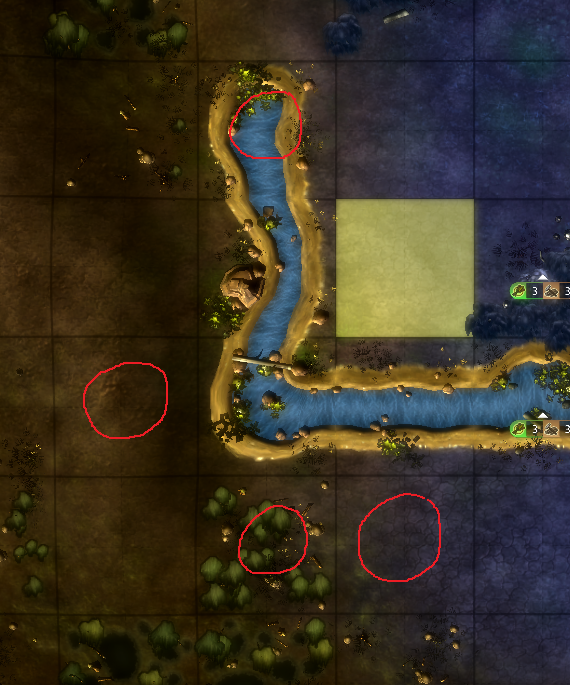
In the above screenshot, the tiles I've put a red circle in have access to at least 2 food (if every river tile is a source of 1 food) and 2 material (if every forest tile is a source of 1 material) yet show no yields.
Using the same common belief of river tiles providing at least one food and forest tiles providing at least on forest makes the following screenshot (from the same map actually, using Cartographer's Table):
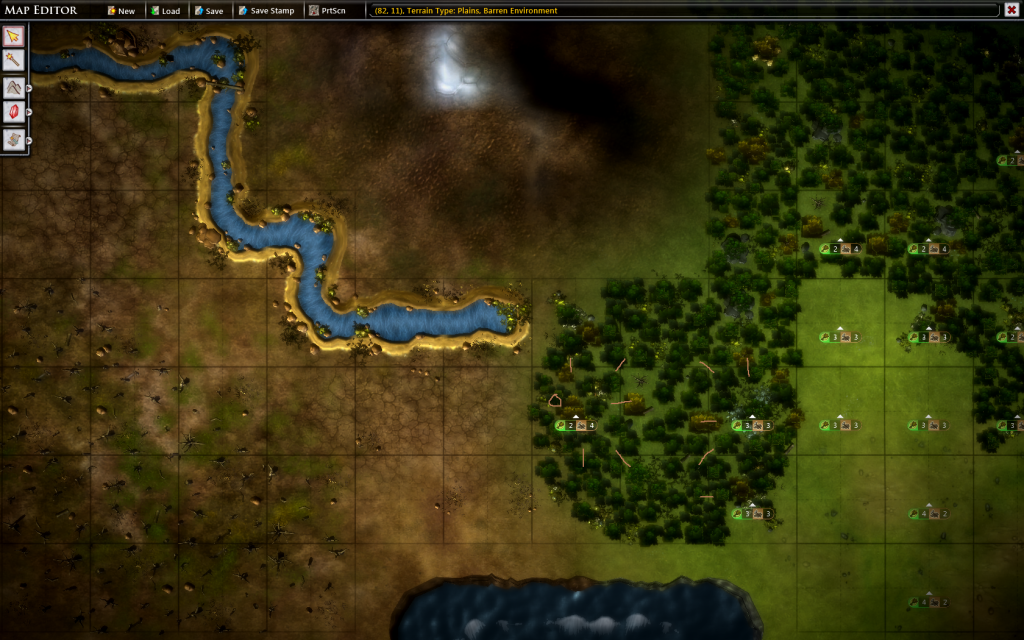
Ignoring the issues of where the food yield is coming from, that 2 Grain/4 Material resource yield display coming from that tile southeast to the river origin seems wrong in that it should, if 1 forest tile = 1 material source, have 6 Material, not 4 (counting the tile itself, assuming of course that forest tiles are each a source of 1 material).
Using the lack of fog of war generating a map on the Cartographer's Table, I did notice that the vast majority of displayed resource grain+food yields totalled exactly 6. There were only a couple exceptions that exceeded this. This seems a bit odd ... which leads me to think the following rules may be used to determine the yield accessible in a tile to a city built there (the displayed yields, not the origins):
- For a yield to display (and thus to permit the settling of a city), a tile's available yield (summed from adjacent tiles) must consist of at least 2 Grain, at least 2 Material and total at least 6 between Grain and Material
- Any amount of Grain+Material that would put the tile's available yield of Grain+Material yield over 6 is divided by at least three or more
That could explain why what should be 2/6 in the aforementioned tile (whatever the origin of the 2 material is) is only 2/4, because 2+4 = 6, what would be an extra 2 material must be divided by at least 3 (which would make it 2 Grain, 4 2/3 Material, if the system always rounds down; if it rounds off normally and 2/3rds would round up, the divisor would then need to be 5 or more which would put the yield at 2 Grain, 4 2/5 Material which rounds down to just 4). Sources adjacent to a tile would, then, need to be more massively abundant to allow for Grain+Material yields of 7 or more which do occur but seem quite rare.


 Elemental Forums
